
Both a totalizer and a batch controller sit downstream of a flow sensor, show quantity and use the same pulse or analogue input. Yet they solve different problems. A totalizer answers "how much has passed?" A batch controller answers "give me exactly this much, then stop." Buying the wrong one leads to workarounds in the PLC or manual intervention at the plant.
What a flow totalizer does
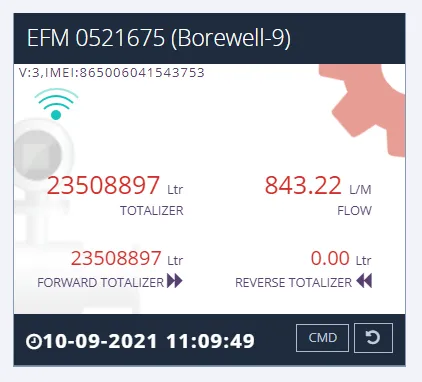
A flow totalizer integrates flow rate over time and displays the accumulated volume or mass. Most units also show instantaneous flow rate and often keep two registers: a resettable one for shift or daily quantities, and a non-resettable one for the lifetime total.
Typical uses include:
- Water consumption by department or process
- Utility cost allocation
- Fill-level inventory of transferred liquids
- Production reporting where the end point is not fixed
The totalizer observes; it does not control. Relay functions vary by model; verify whether a particular unit offers alarms, retransmission or any control sequence.
What a batch controller does
A batch controller accepts a target quantity, opens a valve or starts a pump, counts the incoming flow, and closes or stops when the target is reached. Core functions generally include:
- Preset quantity entry, sometimes multiple recipes
- Start, stop and pause controls
- One or two stage valve control, with a slow "pre-stop" stage near the end to reduce overshoot
- Overrun compensation, because the liquid keeps moving as the valve closes
- Batch counters and cumulative totals
- Alarms for no flow, over-time or leaks after shut-off
Side-by-side comparison
| Question | Totalizer | Batch controller |
|---|---|---|
| Primary job | Record cumulative quantity | Dispense a preset quantity |
| Controls a valve or pump | Depends on model; not necessarily sequenced batching | Yes |
| Operator interaction | Read, reset | Set target, start, stop |
| Typical accuracy concern | Sensor accuracy | Sensor plus valve closing behaviour |
| Wiring effort | Low | Higher: valves, interlocks, start/stop |
| Typical sites | Metering and reporting | Filling, dosing, blending, tanker loading |
If your process always has a defined end quantity, you want a batch controller. If it is continuous or there is no end point, a totalizer is enough.
Choosing: a short decision flow
- Does the process stop automatically at a quantity? Yes: batch controller.
- Is the quantity only reported or billed? Yes: totalizer.
- Do you also need accurate consumption records alongside batching? Many batch controllers keep a cumulative total, so one device may cover both.
- Do you need to control the flow rate itself? Consider the universal flow controller or a dosing application; see dosing controllers in water treatment.
Accuracy: the sensor still sets the limit
Neither device can improve the sensor. A totalizer is only as good as the meter feeding it, and a batch is only as repeatable as the meter and the valve. If you use an electromagnetic flow meter, its pulse output suits direct connection to a counting instrument, and it is wet calibrated at an IEC/ISO/EN 17025 accredited lab. For background on calibration, see flow meter calibration in India.
For batching, repeatability matters more than absolute accuracy: each batch should repeat. Fix the pipework, valve type and flow rate so that conditions are stable.
Installation and setup tips
Pulse input
- Set the K-factor (pulses per unit volume) exactly as on the meter's calibration sheet.
- Keep pulse cables away from motor and VFD cables, and use shielded cable earthed at one end.
- Check input type (open collector, voltage, dry contact) before wiring.
Valve selection for batching
- Use a two-stage arrangement (fast fill then slow trickle) for accuracy at the end of the batch.
- Select a valve that closes quickly and repeatably; a slow actuator makes overrun large.
- Place the valve downstream of the meter, so that the meter stays full.
Overrun compensation
- Run several batches at the normal flow rate.
- Compare the dispensed quantity to a reference, such as a weighed tank.
- Enter the observed overrun as compensation, then repeat.
- Re-tune whenever flow rate or valve type changes.
Common mistakes
- Using a totalizer's alarm relay as a batch stop. It lacks the sequence, overrun and safety logic of a real controller.
- Resetting the lifetime register. Keep the non-resettable total for audit; reset only the batch or shift register.
- Ignoring power failure behaviour. Confirm that totals are retained in memory when power is lost.
- Measuring a half-full pipe. Neither device can correct for air; see diagnosing unstable flow readings.
- No data export. If you need records, check for RS485 or pulse repeat, and consider a data logger for flow meter.
Acceptance checks before handover
Run a documented comparison under representative conditions and retain the original observations. Check that the local display, transmitted value and stored record use the same units and scaling. Include an approved interruption test, then verify recovery without silently resetting totals or losing the configuration. Assign responsibility for reviewing alarms and unexplained gaps. These checks establish a baseline for maintenance rather than proving that the installation will remain correct indefinitely.
Frequently asked questions
Can a batch controller also work as a totalizer?
Often yes, because it counts flow and keeps a cumulative register. Confirm the device keeps a non-resettable total if you need one.
Do I need a different flow meter for batching?
Not necessarily. The same meter can feed both, provided its pulse output resolution is fine enough for the smallest batch you will run.
Which is better for water billing?
Billing is a totalizing function, so a totalizer or a meter with an integral totalizer is usual. Check the legal requirements that apply to your arrangement; an instrument alone does not make a billing system compliant.
Conclusion
Choose a totalizer when you need to know how much has flowed, and a batch controller when you need to deliver a set amount. Get the sensor, K-factor, valve and wiring right, and either will serve reliably for years.
Not sure which fits your process? Talk to Accumax about your application.
Written by the Accumax Engineering Team
The people who design, build and calibrate Accumax instruments in Gandhinagar since 1992.