
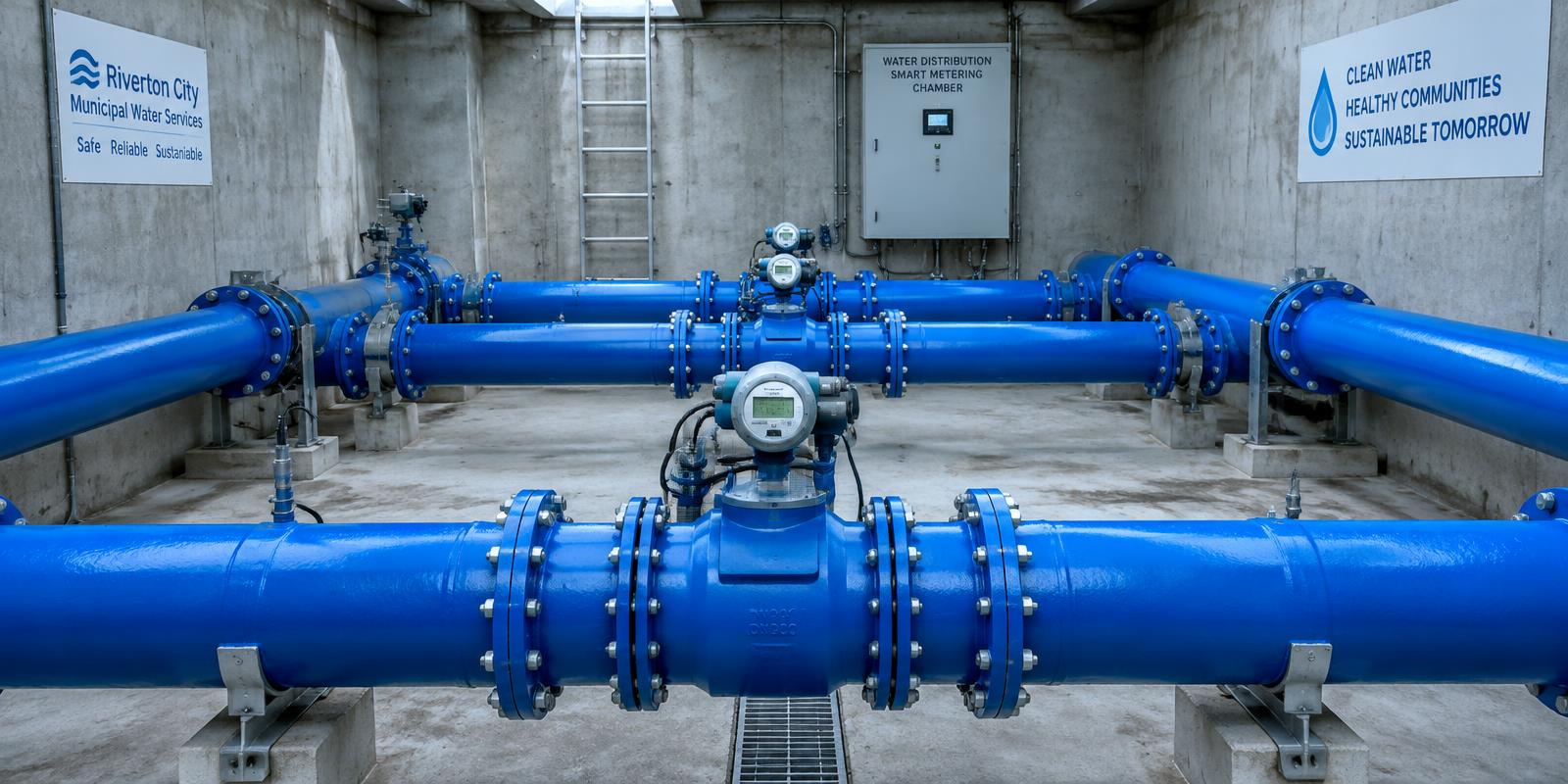
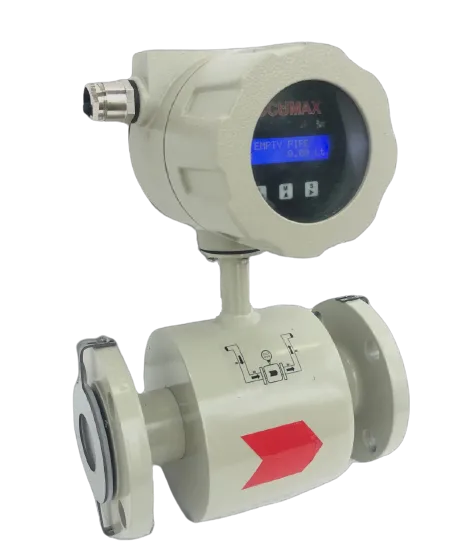
Electromagnetic flow meters are popular because they are obstruction-free, have no moving parts and measure volume flow regardless of density or viscosity. They do have one firm requirement: the liquid must conduct electricity. Understanding that requirement helps you avoid the most common selection error, which is putting a magnetic meter on a fluid that cannot support it.
The electromagnetic flow meter from Accumax is specified for water with conductivity of at least 20 µS/cm. This article explains what that means in practice.
The principle in brief
According to Faraday's law of induction, a conductor moving through a magnetic field generates a voltage. In the meter, the conductor is the liquid itself. The electrodes detect a very small voltage proportional to average velocity, and the transmitter converts it to flow rate using the known pipe area.
Because the signal is so small, the transmitter's input must be very high impedance. The liquid, the electrodes and the electronics form a circuit, and a poorly conductive liquid weakens that circuit, which leaves the signal exposed to electrical noise.
What conductivity means
Conductivity measures how readily a liquid carries current, expressed in microsiemens per centimetre (µS/cm). It depends on dissolved ions. As a rough orientation, not a specification:
| Liquid | Typical conductivity behaviour |
|---|---|
| Ultra-pure or demineralised water | Very low; often unsuitable |
| Distilled water | Low; usually unsuitable |
| Typical tap and groundwater | Often hundreds of µS/cm or more |
| Brackish water, effluent | Higher |
| Dilute acids, alkalis, salt solutions | Usually high |
| Hydrocarbons, oils, solvents | Essentially non-conductive |
Actual values vary with source, season and temperature, so measure rather than assume.
The 20 µS/cm rule for water
For Accumax's electromagnetic meter, water needs conductivity of at least 20 µS/cm. Below that, readings may become unstable, jump or drop to zero. Treat the figure as a minimum for reliable operation, and leave margin: if your water measures 22 µS/cm in the lab, seasonal change could push it under the line.
Note that the limit is stated for water. Other liquids can behave differently, so give the supplier your fluid details.
Fluids that cause trouble
- Demineralised and RO permeate water. Common in boiler feed, pharmaceuticals and electronics. Conductivity is often far too low.
- Hydrocarbons and solvents. Fuels, oils and many organic liquids are non-conductive; consider other technologies such as turbine, positive displacement or Coriolis.
- Two-phase flow. Air bubbles or oil droplets in water interrupt conduction and cause noisy readings.
- Partially filled pipes. The electrodes lose contact with the liquid. A magnetic meter measuring a non-full pipe will read wrongly.
How to check conductivity
- Take a representative sample from the actual line, not a bench container left standing.
- Measure with a calibrated conductivity meter at known temperature. Conductivity rises with temperature, so note the temperature.
- Repeat across different operating conditions, such as after regeneration cycles or seasonal source changes.
- Record the lowest value you see and compare with the meter's minimum.
If your site already has analytical instrumentation, a conductivity reading from the process may already be logged. Our pH analyser page covers related online analysis if you are building a wider monitoring picture.
Practical tips for marginal conductivity
- Choose the shortest, cleanest signal cable and ensure the grounding recommendations are followed. Poor earthing is more damaging at low conductivity.
- Keep the pipe full. Install in a rising section or a U-bend rather than at the top of a long horizontal run. See flow meter installation and straight run.
- Ground the liquid using grounding rings or electrodes when the pipe is plastic or lined, so the liquid is at a defined reference potential.
- Avoid injection points immediately upstream, where chemicals can create layers of different conductivity and cause noisy readings.
- Consider alternatives when conductivity is truly low. The comparison in electromagnetic vs ultrasonic flow meter is a good start.
Conductivity versus electrode material
Higher conductivity does not mean you can ignore chemistry. Highly conductive fluids are often corrosive, so the liner and electrode selection matters. See choosing liner and electrode materials. Equally, coatings on the electrodes can raise contact resistance, and a meter that once worked on low-conductivity water may stop when deposits build up.
Reading the symptoms
| Symptom | Possible conductivity-related cause |
|---|---|
| Reading jumps with no process change | Conductivity close to the minimum, noise pickup |
| Reading falls to zero at low flow | Empty-pipe detection or lost electrode contact |
| Works in summer, fails in winter | Temperature-dependent conductivity |
| Reading drifts over weeks | Electrode coating |
Before blaming the meter, always verify the liquid. For wider diagnosis, see diagnosing unstable flow readings.
Acceptance checks before handover
Run a documented comparison under representative conditions and retain the original observations. Check that the local display, transmitted value and stored record use the same units and scaling. Include an approved interruption test, then verify recovery without silently resetting totals or losing the configuration. Assign responsibility for reviewing alarms and unexplained gaps. These checks establish a baseline for maintenance rather than proving that the installation will remain correct indefinitely.
Frequently asked questions
What is the minimum conductivity for the Accumax electromagnetic flow meter?
For water, conductivity must be at least 20 µS/cm. Allow a safety margin for variation in your process.
Can an electromagnetic meter measure oil or fuel?
Generally not, because these liquids are essentially non-conductive. Another measurement principle should be selected.
Does temperature change conductivity?
Yes. Conductivity usually increases with temperature, so measure at representative conditions, including the coldest operating case.
Conclusion
Conductivity is the gatekeeper for magnetic flow measurement. Verify it with a real sample, keep a margin above the 20 µS/cm minimum for water, keep the pipe full, and ground properly. If the liquid does not qualify, choose a different principle rather than forcing the fit.
Unsure whether your liquid is suitable? Send us the details through our contact page.
Written by the Accumax Engineering Team
The people who design, build and calibrate Accumax instruments in Gandhinagar since 1992.